
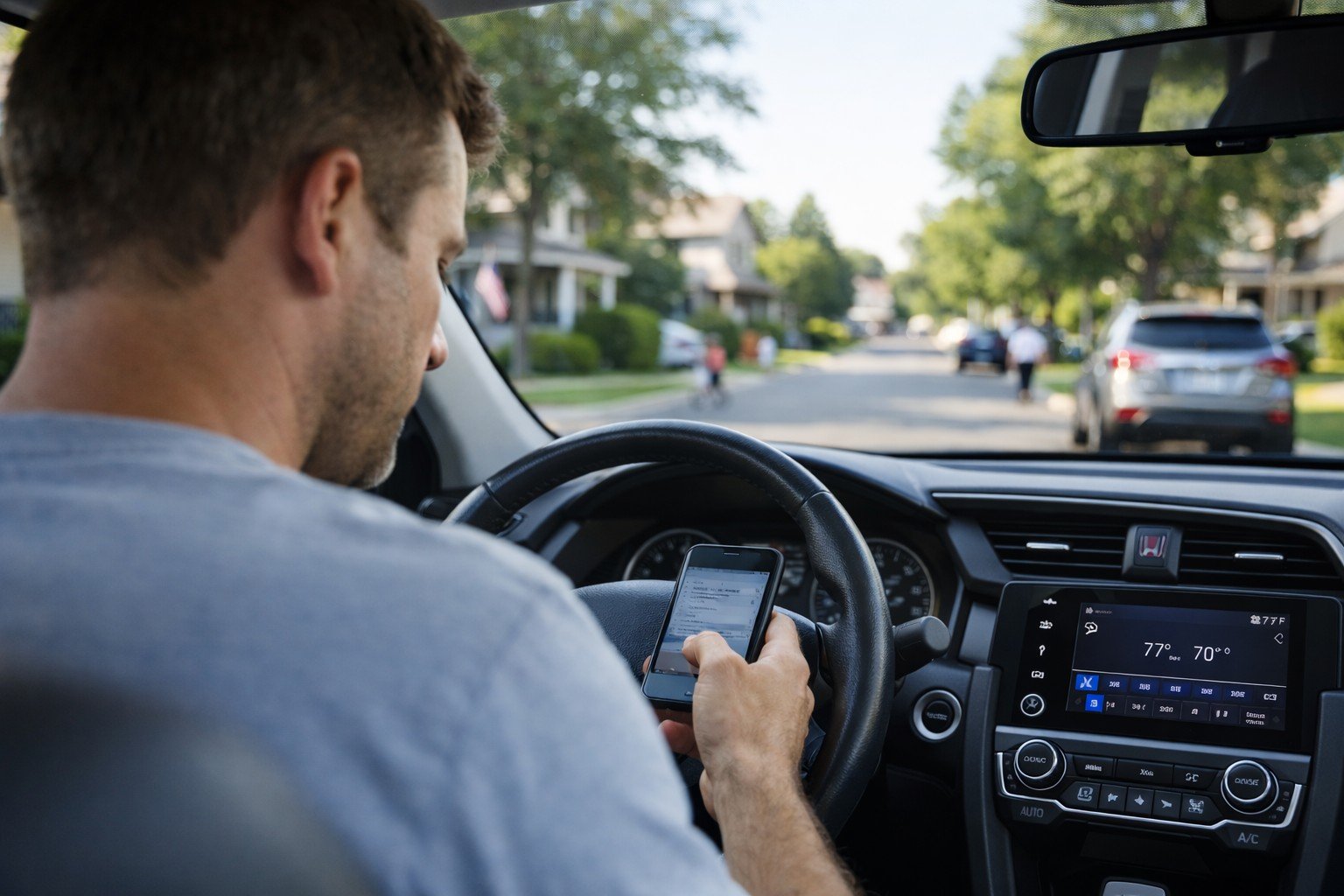
The Hidden Dangers of Distracted Driving in Residential Neighborhoods
When people think about traffic accidents, they often imagine high speed collisions on highways or congested arterial roads. Residential driving risks rarely come to mind, even though neighborhood streets consistently produce serious injuries. These roadways feel familiar, slower, and more forgiving, which leads many drivers to relax their attention. This assumption is precisely what makes residential neighborhoods so dangerous.
Residential driving risks are rooted in unpredictability rather than speed. Children playing near the curb, pedestrians stepping out between parked cars, cyclists navigating tight lanes, and delivery vehicles stopping abruptly all converge in areas that were never designed for constant vehicle movement. Unlike controlled intersections or multilane roads, neighborhood streets offer limited visibility, narrow margins for error, and few escape routes when something goes wrong.
Distracted driving within these settings compounds every existing hazard. A brief glance at a phone, a moment spent adjusting navigation, or an in car conversation that diverts attention can result in life altering injuries within seconds. The danger is not hypothetical. It is a daily reality on residential streets throughout Florida.
Why Residential Driving Risks Increase When Drivers Lower Their Guard
Drivers tend to associate danger with speed and congestion. When neither is immediately present, vigilance declines. Residential neighborhoods feel controlled and predictable, even though they are anything but. Familiar routes and repeated driving patterns encourage autopilot behavior rather than active observation.
This false sense of safety often leads drivers to multitask. Checking messages, reviewing directions, or adjusting music feels low risk because the environment appears calm. Unfortunately, calm does not mean safe. Residential streets demand constant scanning because hazards can emerge without warning.
Children do not follow traffic patterns. Pedestrians cross mid block. Vehicles pull out of driveways with limited visibility. When attention drops, reaction time disappears. The combination of lowered guard and distraction is one of the most consistent contributors to neighborhood crashes.
Common Distractions That Lead to Residential Accidents
Distracted driving in neighborhoods is rarely caused by dramatic behavior. Instead, it stems from routine habits drivers underestimate. These everyday distractions are especially dangerous in close proximity environments.
Common distractions include mobile phone notifications, navigation prompts, passenger conversations, and visual distractions inside the vehicle. Even hands free technology can divert attention away from scanning sidewalks, driveways, and parked vehicles.
In residential areas, hazards are not confined to the roadway itself. They appear from the edges. A distracted driver may fail to notice movement behind a parked car or a child stepping off a curb. These moments require immediate reaction, which distraction eliminates.
Children and Pedestrians Face the Highest Risk
Residential neighborhoods are shared spaces. Streets function as play areas, walking routes, and gathering zones in addition to vehicle corridors. Children, in particular, are drawn to these environments and often play close to traffic.
Children have limited ability to judge speed and distance. They may dart into the street unexpectedly or chase toys without awareness of approaching vehicles. Distracted drivers are far less likely to notice these movements in time to stop.
Pedestrians in neighborhoods also behave differently than in downtown areas. People walk dogs, push strollers, or cross mid block to reach nearby homes. These actions are common and expected in residential settings, yet they demand heightened driver awareness that distraction undermines.
Delivery Vehicles and Neighborhood Congestion
Modern residential traffic patterns have changed dramatically. Food delivery services, package carriers, rideshare vehicles, and home service providers now operate continuously within neighborhoods. These vehicles stop frequently, block sightlines, and alter traffic flow without warning.
Drivers navigating around delivery vehicles must make quick decisions in tight spaces. A distracted driver may fail to notice sudden stops or a delivery worker stepping into the roadway. Narrow streets offer little room to adjust.
This congestion increases the likelihood of sideswipe collisions, backing incidents, and pedestrian strikes. These accidents often occur at low speeds but can still result in severe injuries due to proximity and limited reaction time.
Blind Driveways and Parked Cars Limit Visibility
Residential streets are filled with visual obstructions. Parked vehicles line curbs, fences block corners, and landscaping restricts sightlines. Driveways often connect directly to streets without clear visibility in both directions.
A distracted driver may miss a vehicle pulling out of a driveway or a pedestrian emerging from behind a parked car. These situations unfold quickly and leave no margin for error.
Visibility challenges are especially dangerous for children and cyclists, who are smaller and harder to see. Distraction removes the ability to anticipate these movements before they occur.
Cul De Sacs and Narrow Streets Increase Risk
Cul de sacs are often viewed as the safest residential road design. While they reduce through traffic, they concentrate movement into confined areas. Vehicles frequently reverse, children play near turning zones, and visibility is often limited.
Backing accidents are common in cul de sacs, particularly when drivers are distracted. A momentary lapse in attention can result in striking a pedestrian, cyclist, or another vehicle.
Narrow streets further amplify risk by reducing clearance and forcing vehicles to pass closely. These environments demand full attention at all times.
Common Injury Patterns in Residential Distracted Driving Accidents
Neighborhood crashes tend to follow consistent patterns. These include pedestrian impacts, cyclist strikes, backing collisions, and sideswipe accidents.
Injuries commonly associated with these incidents include traumatic brain injuries, neck and spinal damage, fractures, internal injuries, and severe soft tissue trauma. Pedestrians often suffer multiple injuries due to both vehicle impact and secondary contact with the roadway.
Many symptoms may not appear immediately, especially in head and neck injuries. This delay can complicate medical evaluation and recovery.
Challenges After Residential Driving Accidents
Residential accidents often involve disputes over fault. Drivers may claim low speed minimized risk or argue they did not see the pedestrian or cyclist. Limited witnesses and unclear visibility conditions complicate investigations.
Common challenges include conflicting statements, lack of surveillance footage, unclear vehicle positioning, and delayed injury symptoms. These factors can make documentation and timely medical evaluation critical.
What to Do After a Residential Driving Accident
The steps taken after a neighborhood crash can significantly affect both health outcomes and documentation quality.
Step 1: Seek medical evaluation, even if injuries appear minor.
Step 2: Photograph the scene, including parked vehicles, driveways, and sight obstructions.
Step 3: Collect witness contact information when available.
Step 4: Document lighting conditions and visibility limitations.
Step 5: Monitor symptoms that develop later and record them.
Residential injuries often worsen over time, particularly soft tissue and head injuries.
Frequently Asked Questions
Why are residential streets dangerous despite lower speeds?
Residential streets involve unpredictable movement, limited visibility, and close proximity between vehicles and pedestrians. These factors increase risk even at low speeds.
Are children more vulnerable in residential accidents?
Yes. Children move unpredictably and have limited ability to judge traffic, making them especially vulnerable to distracted drivers.
Do delivery vehicles increase neighborhood accident risk?
Yes. Frequent stops, blocked sightlines, and increased congestion raise the likelihood of collisions.
Can injuries appear hours or days later?
Yes. Adrenaline can mask pain initially. Head, neck, and soft tissue injuries often develop later.
Summary: Why Distracted Driving Is Especially Dangerous Near Home
Residential neighborhoods combine unpredictable movement, limited visibility, and shared space into environments where distraction carries serious consequences. Children, pedestrians, cyclists, and delivery traffic all intersect in areas that demand full driver attention.
Residential driving risks are not defined by speed, but by proximity and exposure. Distracted driving in these environments turns ordinary moments into life altering events within seconds.
Understanding these dangers explains why neighborhood safety deserves the same seriousness as highway travel.
Contact Lawlor, White & Murphey Today
If you or someone you know has experienced delayed medical care after a car accident, don’t wait any longer. Your health and your legal rights depend on timely action. Speak with a qualified personal injury attorney who can guide you through the process, help you gather evidence, and fight for the compensation you deserve.
Take the next step—schedule a free consultation with Lawlor, White & Murphey today.