
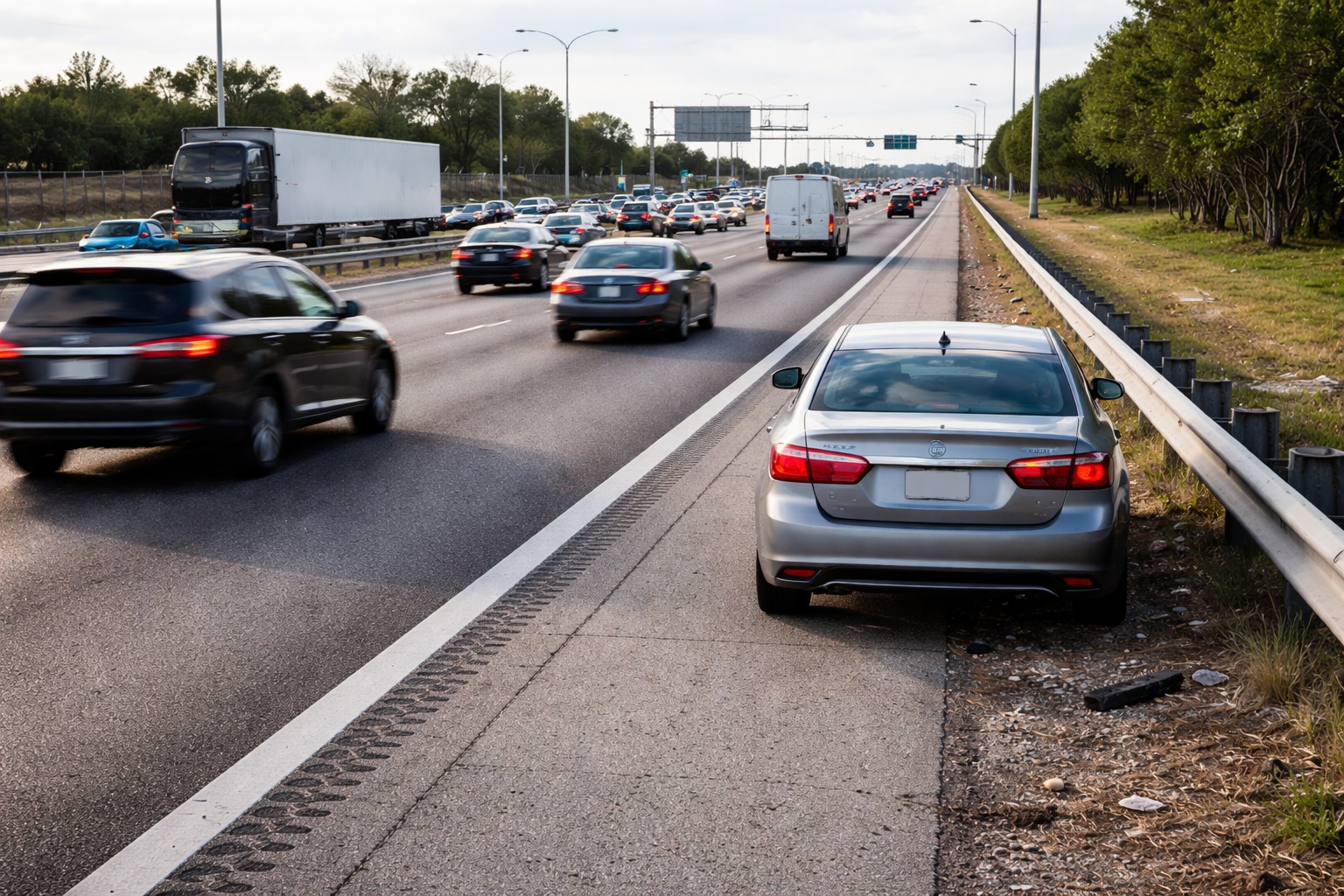
Why Highway Shoulder Breakdowns Often Turn Into High Speed Collision Zones
Highway shoulders are commonly viewed as safe refuge zones where drivers can pull over during mechanical issues, flat tires, or momentary emergencies. The assumption is that stepping out of traffic removes immediate danger and creates time to assess the situation. In reality, shoulder collision risks on Florida highways tell a very different story. These narrow strips of pavement place disabled vehicles and occupants inches away from traffic moving at highway speeds.
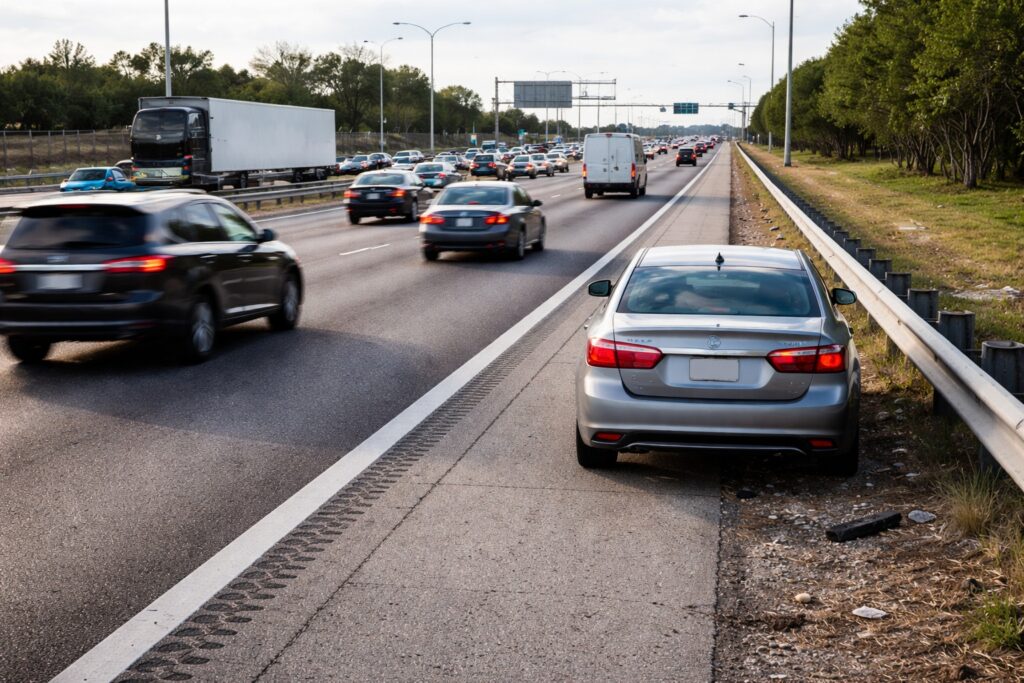
Florida’s interstates carry constant, high volume traffic with minimal gaps between vehicles. When a car stops on the shoulder, it does not exit the flow of traffic so much as become a stationary obstacle alongside it. The closing speed between moving vehicles and a stopped car can exceed 70 miles per hour, leaving little margin for error when drivers drift, lose focus, or react late.
The Illusion of Safety on Highway Shoulders
The perception of safety on highway shoulders is rooted in their intended purpose. Shoulders are designed as emergency stopping areas, not as long term safe zones. On many Florida highways, shoulders are narrow, uneven, or partially obstructed by debris. Drivers who pull over often find themselves closer to active lanes than expected.
Shoulder collision risks increase because drivers in adjacent lanes rarely adjust behavior significantly. Traffic continues at full speed, and vehicles pass within feet of the stopped car. This proximity exposes occupants to sudden impacts from sideswipes, debris strikes, or vehicles that leave the travel lane unexpectedly.
Unlike surface streets, highways provide no natural speed reduction near shoulder areas. Drivers approaching at speed may not recognize a stopped vehicle until they are already alongside it, particularly at night or in heavy traffic.
Narrow Shoulders and Limited Recovery Space
Many Florida interstates were built decades ago and later expanded to accommodate traffic growth. In some areas, lane additions reduced shoulder width or eliminated full shoulders altogether. Narrow shoulders leave little space for disabled vehicles to pull fully out of traffic.
When a vehicle cannot clear the lane entirely, even a few inches of encroachment increases collision risk. Passing drivers may swerve slightly to maintain clearance, creating chain reactions that affect multiple lanes. Large vehicles such as SUVs, delivery vans, and trucks often extend further into the shoulder space, increasing exposure.
Limited recovery space also affects drivers who lose control momentarily. Tire blowouts, distracted driving, or sudden lane changes can cause vehicles to drift onto the shoulder. When a stopped car is present, there is no buffer to absorb that mistake.
High Closing Speeds and Driver Reaction Limits
Highway driving depends heavily on anticipation and peripheral awareness. Drivers expect traffic to flow uniformly and rely on consistency to maintain speed. A stationary vehicle on the shoulder breaks that expectation.
Shoulder collision risks rise sharply because of the speed differential between moving traffic and stopped vehicles. At highway speeds, drivers have seconds or less to recognize hazards and react. Even attentive drivers may struggle to adjust in time if visibility is limited or traffic density restricts maneuvering.
Fatigue and distraction further reduce reaction time. Long stretches of uninterrupted driving common on Florida interstates can dull attention. When a driver glances away or drifts slightly, the shoulder becomes a danger zone rather than a safety buffer.
How Traffic Density Amplifies Shoulder Collision Risks
Florida highways often operate near or above capacity, especially during commuting hours, tourist seasons, and holiday travel. High traffic density reduces spacing between vehicles and limits lateral movement.
When traffic is tightly packed, drivers have fewer options to move away from shoulder hazards. Lane changes become difficult, and braking distances shorten. A sudden swerve to avoid a shoulder obstruction can trigger rear end collisions or sideswipes across multiple lanes.
Merging traffic further complicates the environment. On ramps and exit areas, vehicles accelerate and decelerate simultaneously. A stopped vehicle on the shoulder near these zones increases complexity and reduces predictability for approaching drivers.
The Role of Commercial Trucks and Oversized Vehicles
Commercial trucks play a significant role in shoulder collision risks due to their size, weight, and operating characteristics. Trucks require more time and distance to change lanes or slow down. When a stopped vehicle appears unexpectedly on the shoulder, truck drivers may have limited ability to adjust.
Wind turbulence from passing trucks can also destabilize stopped vehicles or occupants standing nearby. The force generated by a large truck passing at speed can pull or push smaller vehicles toward traffic.
Oversized trailers and wide loads further reduce clearance between travel lanes and shoulders. In these situations, even a properly parked vehicle may be dangerously close to passing equipment.
Environmental and Roadway Factors That Increase Danger
Environmental conditions often worsen shoulder collision risks without drawing immediate attention. Weather, lighting, and roadway design all play critical roles.
Rain reduces traction and visibility, increasing stopping distances and making lane drift more likely. At night, limited lighting along rural stretches of highway can obscure stopped vehicles until drivers are nearly upon them. Curves and overpasses restrict sightlines, shortening the time available to react.
Road debris commonly accumulates along shoulders. Broken tire fragments, vehicle parts, and construction materials create hazards for both stopped vehicles and passing traffic. Uneven pavement and drop offs further limit safe footing for occupants who exit their vehicles.
- Reduced visibility near curves and overpasses
Sightlines are often blocked until the last moment, especially at highway speeds. Drivers may not see a stopped vehicle until evasive options are limited. - Debris accumulation along shoulders
Shoulders collect tire fragments, metal parts, and roadway debris. These hazards can damage vehicles or force sudden maneuvers. - Weather related traction loss
Wet pavement increases stopping distances and reduces steering control. Vehicles are more likely to drift toward the shoulder during braking. - Lighting limitations at night
Many highway shoulders are poorly lit, making stationary vehicles harder to detect until close proximity.
Common Collision Patterns Involving Highway Shoulders
- Sideswipe impacts
Vehicles drift slightly out of the travel lane and strike stopped cars or occupants on the shoulder. - Rear end collisions near merge zones
Sudden braking to avoid shoulder hazards leads to rear end impacts in congested traffic. - Secondary collisions after initial breakdowns
A disabled vehicle may be struck multiple times as traffic reacts unpredictably. - Debris related impacts
Passing vehicles strike debris from breakdowns, causing loss of control or damage.
Injury Consequences From Shoulder Related Collisions
Shoulder collisions often result in severe injuries due to the speed involved. Even when the initial contact appears minor, secondary impacts can occur moments later. Occupants standing outside vehicles face particularly high risk.
Injuries frequently involve the neck, spine, and head due to sudden force and lack of protection. Soft tissue injuries, fractures, and traumatic brain injuries are common in high speed shoulder incidents. Delayed symptoms may emerge after the adrenaline of the incident subsides.
Because these collisions often happen unexpectedly, occupants may not have time to brace or seek cover. This increases the likelihood of serious harm even in collisions that appear avoidable in hindsight.
What to Do After a Highway Shoulder Collision or Near Miss
The steps taken after a shoulder related incident can affect both health outcomes and the clarity of what occurred. Even near misses or minor impacts can involve forces capable of causing injury.
Important actions after a highway shoulder incident include:
- Seek medical evaluation promptly
High speed exposure and sudden movement can cause injuries that are not immediately apparent. - Document the scene if safe to do so
Photograph vehicle position, shoulder width, nearby traffic conditions, and roadway features. - Note environmental conditions
Record lighting, weather, and visibility factors that may have contributed to the incident. - Monitor delayed symptoms
Pain, stiffness, dizziness, or headaches may appear hours or days later.
Frequently Asked Questions
Why are highway shoulders in Florida so dangerous during breakdowns?
Shoulder collision risks increase because a stopped vehicle remains extremely close to traffic moving at highway speeds. Many shoulders are narrow, uneven, or partially obstructed, leaving little buffer between the disabled vehicle and active lanes. High traffic volume on Florida interstates also reduces the space drivers have to react if they drift or notice the stopped vehicle late.
What types of crashes are most common in shoulder breakdown zones?
Sideswipe impacts are common when vehicles drift out of the travel lane and make contact with a stopped vehicle. Rear end collisions can also occur when drivers brake suddenly in dense traffic after noticing a shoulder hazard. Secondary collisions are another frequent pattern, particularly when the initial impact leaves vehicles positioned in or near active lanes.
How do trucks and commercial traffic affect shoulder collision risks?
Large trucks require more distance to slow down and more space to change lanes, which reduces their ability to adjust quickly near shoulder hazards. Passing trucks also create wind turbulence that can destabilize a stopped vehicle or affect footing for occupants outside the car. Oversized equipment reduces clearance, increasing risk even when a disabled vehicle is fully on the shoulder.
Do weather and visibility conditions make shoulder incidents worse?
Yes. Rain reduces traction and increases stopping distances, making lane drift and delayed braking more likely. Poor lighting, curves, and overpasses shorten the sightline drivers have to detect a stopped vehicle. These conditions compress reaction time and increase the chance of late avoidance maneuvers that trigger collisions.
Can injuries from a highway shoulder collision appear later?
Yes. Even if the impact seems minor, sudden force can strain the neck, back, and soft tissue, and symptoms may develop as inflammation increases. Adrenaline can mask discomfort at the scene. Stiffness, headaches, and reduced mobility are commonly reported hours or days later.
Summary: Why Highway Shoulders Remain High Risk Collision Zones
Shoulder collision risks persist because highways were not designed to safely accommodate stopped vehicles alongside high speed traffic. Narrow shoulders, limited visibility, and high closing speeds create environments where even brief roadside stops become dangerous.
Traffic density, commercial vehicles, and environmental factors further compress reaction time and space. Understanding these dynamics explains why highway shoulder breakdowns in Florida frequently lead to serious collisions and severe injuries.
Contact Lawlor, White & Murphey Today
If you or someone you know has experienced delayed medical care after a car accident, don’t wait any longer. Your health and your legal rights depend on timely action. Speak with a qualified personal injury attorney who can guide you through the process, help you gather evidence, and fight for the compensation you deserve.
Take the next step—schedule a free consultation with Lawlor, White & Murphey today.