
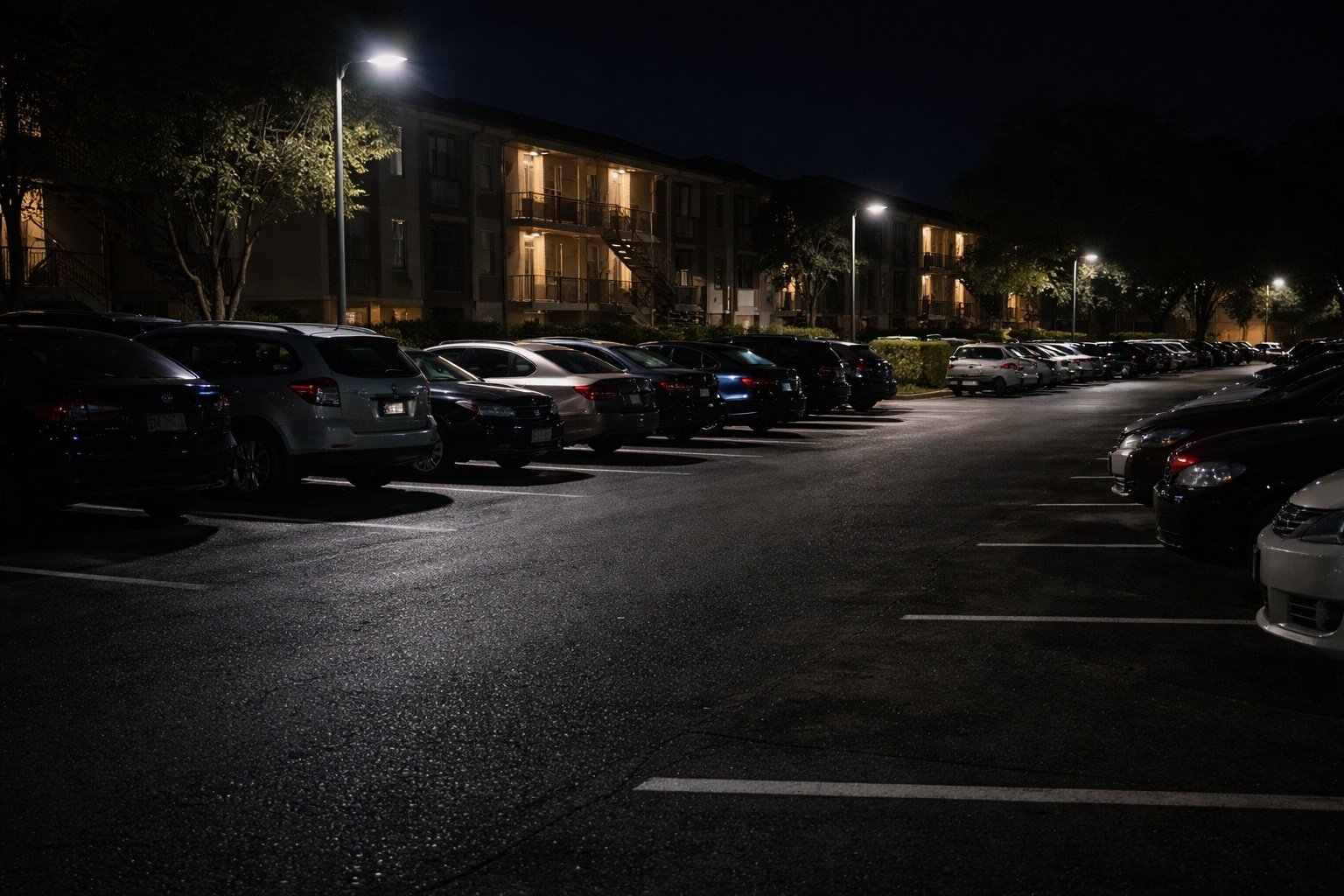
How Poor Lighting in Apartment Parking Lots Increases Vehicle Accident Risks
Apartment parking lots are often treated as low speed, low risk environments, yet poor visibility can turn these spaces into frequent sites of vehicle accidents and pedestrian injuries. Drivers rely heavily on visual cues when navigating parking areas, especially at night. When lighting is inadequate, reaction time shortens and depth perception degrades. Apartment parking lighting failures create conditions where even cautious drivers struggle to see hazards clearly.
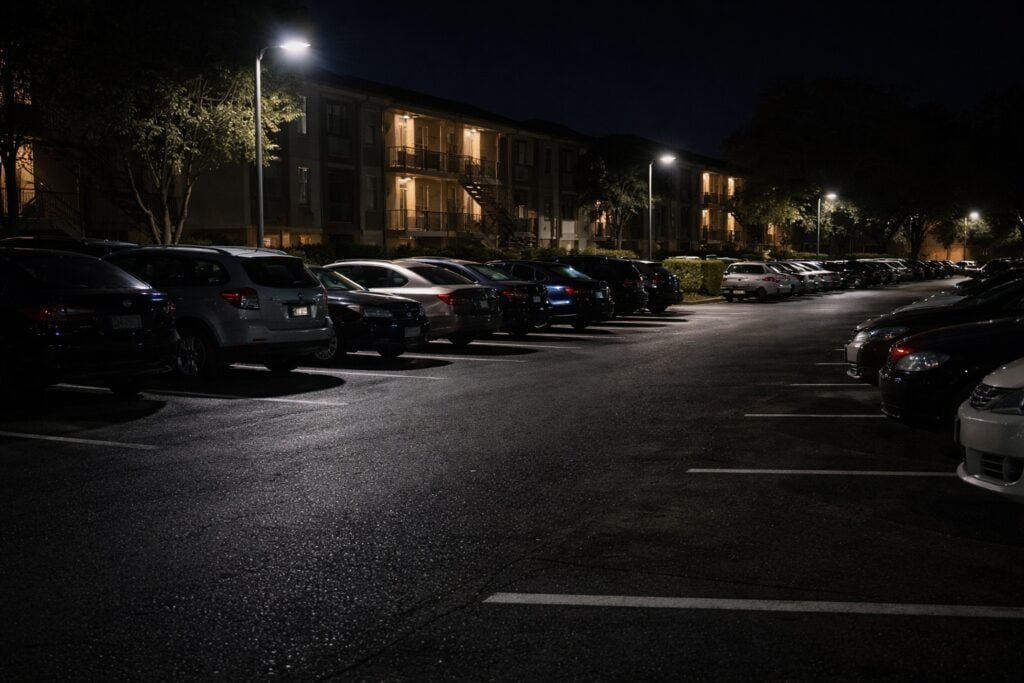
Residents moving between vehicles and buildings are also exposed. Shadowed walkways, unlit parking stalls, and dark corners near stairwells reduce visibility precisely where people enter and exit vehicles. These conditions increase the likelihood of backing collisions, pedestrian strikes, and vehicle damage.
Why Lighting Is Critical in Parking Environments
Parking lots require a different type of visibility than roadways. Drivers move slowly but make frequent directional changes, reverse maneuvers, and tight turns. Adequate apartment parking lighting helps drivers judge distance, identify pedestrians, and recognize obstacles such as curbs, speed bumps, and parked vehicles.
When lighting is poor, drivers rely on headlights alone. Headlights create narrow beams and deep shadows that distort perception. Pedestrians wearing dark clothing or walking between parked cars may not be visible until the final moment. This lack of ambient light reduces the margin for error during routine movements.
Unlike streets, parking lots lack consistent traffic flow. Vehicles enter, exit, stop, and reverse unpredictably. Without proper lighting, these movements become difficult to anticipate.
Backing Collisions and Limited Rear Visibility
Backing accidents are among the most common incidents in poorly lit apartment parking lots. Drivers reversing out of spaces depend on mirrors, cameras, and peripheral vision to detect approaching vehicles or pedestrians. Apartment parking lighting failures limit the effectiveness of these tools.
Darkness reduces contrast between vehicles, pavement, and surroundings. Shadows created by buildings, trees, or parked cars further obscure visibility. Drivers may misjudge how close another vehicle is or fail to see a pedestrian walking behind the car.
These collisions often occur at low speeds, but they can still cause injury and property damage. Pedestrians struck during backing incidents are particularly vulnerable due to limited reaction time.
Pedestrian Exposure Near Vehicles
Apartment parking lots serve both vehicles and foot traffic. Residents walk to and from their homes carrying groceries, managing children, or navigating pets. Poor apartment parking lighting makes it difficult for drivers to detect these movements, especially near crosswalks or building entrances.
Pedestrians may step into driving lanes from between parked cars, assuming drivers can see them. In low light conditions, this assumption fails. Drivers navigating tight spaces may focus on avoiding other vehicles rather than scanning for foot traffic.
Lighting gaps near stairwells, mail areas, and trash enclosures further increase risk. These locations often experience higher foot traffic but receive less illumination.
Shadowed Areas and Visual Deception
Uneven lighting creates shadowed zones that distort perception. Drivers moving from a well lit area into a darker section experience temporary visual adjustment. During this transition, hazards may not register immediately.
Apartment parking lighting issues are often uneven rather than uniformly dim. Burned out fixtures, aging bulbs, or inconsistent coverage leave patches of darkness that confuse drivers. A vehicle or person partially in shadow may appear farther away or stationary when they are not.
These visual inconsistencies increase the likelihood of misjudged turns, sideswipes, and pedestrian impacts.
Aging Infrastructure and Maintenance Gaps
Older apartment complexes are especially vulnerable to lighting failures. Outdated wiring, aging fixtures, and infrequent inspections contribute to prolonged outages. Temporary lighting solutions may not provide adequate coverage.
Apartment parking lighting problems may persist unnoticed by management, especially in less trafficked sections of a property. Residents may adapt by avoiding certain areas, but drivers unfamiliar with the layout remain exposed to risk.
Delayed maintenance increases the duration and severity of hazardous conditions, allowing minor visibility issues to escalate into accident patterns.
Slip Hazards and Surface Visibility
Lighting affects more than collision risk. Poor visibility also increases slip and fall hazards. Drivers and pedestrians may not see oil spots, uneven pavement, or debris on the ground.
In Florida, rainwater accumulates quickly in parking areas. Without proper lighting, wet surfaces become difficult to detect. This increases the risk of slipping while exiting vehicles or walking toward buildings.
Surface hazards near curbs and ramps are particularly dangerous when lighting is insufficient.
Common Accident Patterns Linked to Poor Parking Lot Lighting
- Backing collisions
Drivers fail to see vehicles or pedestrians while reversing. - Pedestrian impacts
Residents are struck while walking between cars or crossing lanes. - Sideswipe incidents
Vehicles misjudge clearance in tight, shadowed spaces. - Trip and fall injuries
Poor visibility hides uneven pavement or slick surfaces.
Injury Consequences of Parking Lot Accidents
Accidents in apartment parking lots often involve unexpected contact. Pedestrians may be caught off guard, and drivers may not have time to react.
Common injuries include head injuries, fractures, back and neck strain, and soft tissue damage. Slip and fall injuries can result in wrist, hip, or ankle trauma. As with many low speed incidents, symptoms may not be immediately apparent.
Delayed pain and mobility issues are common, especially when injuries occur at awkward angles or involve sudden stops.
What to Do After a Parking Lot Accident
The steps taken after an accident in a poorly lit parking lot can influence health outcomes and documentation clarity. Visibility conditions may change quickly as lighting or traffic patterns shift.
Important actions after a parking lot accident include:
- Seek medical evaluation promptly
Injuries may not be obvious immediately. - Document lighting conditions
Photograph burned out fixtures, shadowed areas, and overall visibility. - Record time and location
Note where lighting was insufficient and when the incident occurred. - Monitor delayed symptoms
Pain, stiffness, or dizziness may develop later.
Summary: Why Apartment Parking Lighting Remains a Critical Safety Issue
Apartment parking lighting plays a central role in preventing vehicle accidents and pedestrian injuries. Poor illumination reduces visibility, distorts depth perception, and limits reaction time in spaces already constrained by parked vehicles and foot traffic.
Aging infrastructure, uneven maintenance, and shadowed layouts amplify these risks. Understanding how lighting failures contribute to accidents helps explain why parking lots remain common sites of preventable injuries.
Frequently Asked Questions
Why are parking lot accidents common even at low speeds?
Limited visibility and tight spaces reduce reaction time and margin for error.
Do lighting issues affect pedestrians more than drivers?
Pedestrians are especially vulnerable because drivers may not see them until too late.
Are older apartment complexes at higher risk?
Yes. Outdated lighting systems and maintenance gaps increase failure rates.
Can poor lighting contribute to slip and fall injuries?
Yes. Dim lighting hides wet surfaces, debris, and uneven pavement.
Can injuries appear later after a parking lot accident?
Yes. Adrenaline can mask pain, and symptoms may develop hours or days later.
Contact Lawlor, White & Murphey Today
Accidents in poorly lit apartment parking lots often raise questions about visibility, safety, and responsibility. Because these incidents occur in shared residential spaces, understanding what happened can be challenging. Speak with a qualified personal injury attorney who can guide you through the process, help you gather evidence, and fight for the compensation you deserve.
Take the next step—schedule a free consultation with Lawlor, White & Murphey today.