
Beachfront Traffic Congestion and Seasonal Driving Hazards in Florida
Beachfront roads across Florida are often perceived as relaxed driving environments where traffic moves slowly and predictably near scenic coastal areas. Drivers expect a steady pace, clear visibility, and manageable congestion as they approach beach access points. However, the reality of beachfront traffic hazards reveals a far more complex and unstable traffic pattern, particularly during weekends, holidays, and peak tourist seasons.
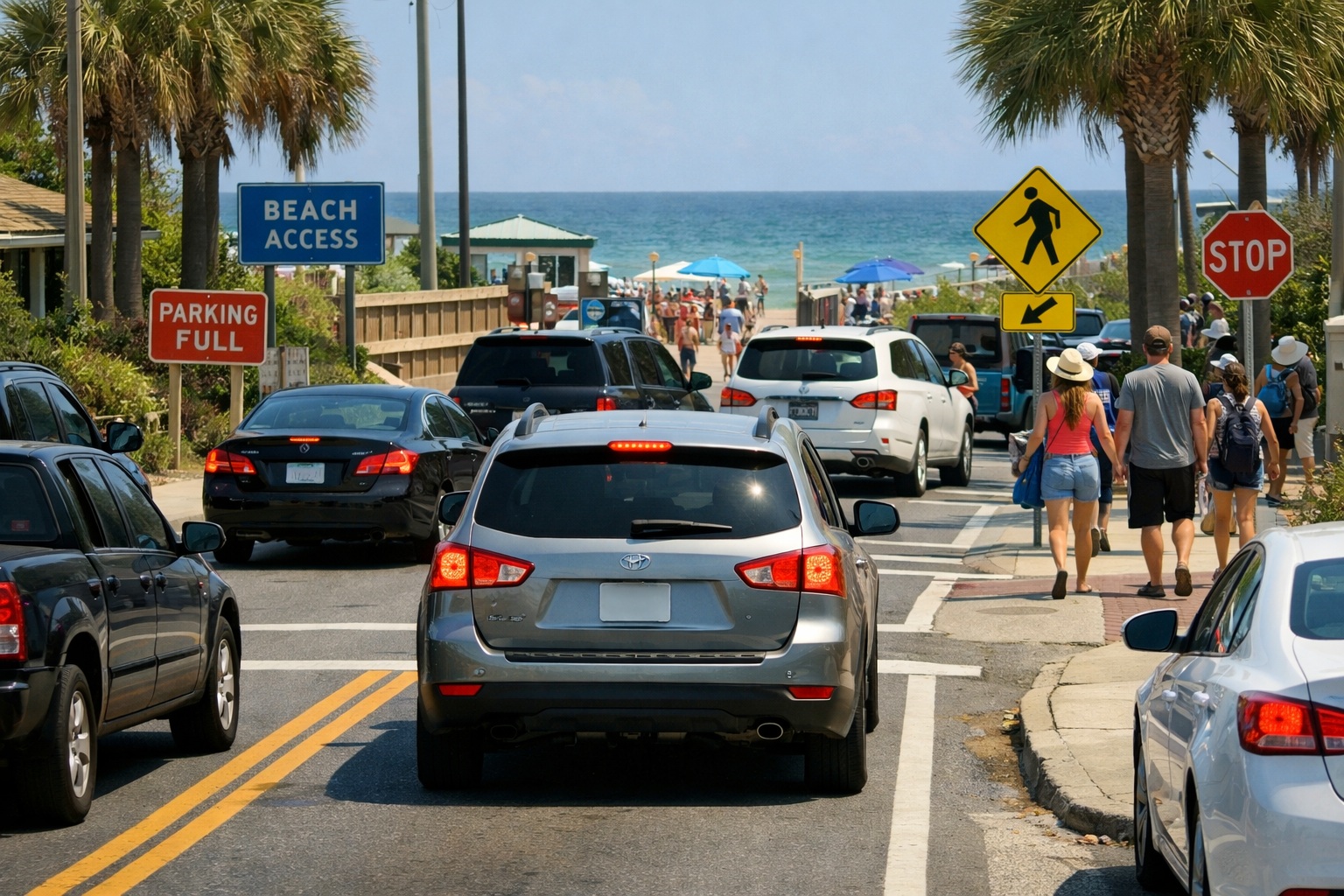
These coastal corridors operate under fluctuating demand that compresses vehicles, pedestrians, and parking activity into limited roadway space. As drivers search for parking, slow unexpectedly, or navigate unfamiliar layouts, the consistency of traffic flow begins to break down. This creates an environment where reaction time is reduced, spacing between vehicles tightens, and sudden changes in movement increase the likelihood of collisions.
Pressure Behind the Beachfront Traffic
Beachfront corridors are not designed to absorb high volumes of vehicles continuously entering and exiting access points. These roads must accommodate through traffic, local drivers, rideshare activity, and visitors searching for parking, all within a confined coastal layout. The result is a constant interruption of traffic flow that forces drivers to adjust speed and positioning in short intervals.
Parking demand is a primary source of disruption. Drivers often slow significantly while scanning for open spaces or waiting for pedestrians to vacate parking areas. Vehicles may stop partially in active lanes while attempting to parallel park or enter crowded lots. This creates sudden slowdowns that ripple backward through traffic, forcing trailing drivers to brake abruptly.
The proximity of pedestrian activity further compresses the driving environment. Crosswalks, beach access points, and informal crossing areas introduce continuous movement across traffic lanes. Drivers must divide attention between vehicles ahead and pedestrians entering the roadway, reducing their ability to anticipate changes in traffic flow.
Expectation Failure in Beachfront Traffic Hazards
Drivers rely on predictable movement patterns when navigating roads, but beachfront environments disrupt these expectations. Instead of gradual speed changes and consistent lane behavior, drivers encounter hesitation, sudden stops, and unpredictable positioning from surrounding vehicles.
Out-of-state drivers and tourists contribute to this expectation failure. Unfamiliar with local traffic patterns, they may slow suddenly when approaching beach entrances, miss turns, or attempt last-second lane changes. Navigation systems can also prompt abrupt adjustments as drivers realize they are near their destination, leading to unexpected braking or turning movements.
Visual cues in these areas are often inconsistent. Parked vehicles, landscaping, and pedestrian activity can obscure sightlines, making it difficult to detect changes in traffic ahead. Drivers are forced to react based on limited information, increasing the likelihood of delayed braking and misjudged spacing between vehicles.
Environmental and Secondary Factors
Beachfront traffic conditions are further influenced by environmental variables that change throughout the day and across seasons. These factors add another layer of complexity to already unstable traffic flow.
- Bright sunlight reflecting off water and sand can reduce visibility, making it harder to judge distance and detect brake lights ahead. This glare is especially pronounced during midday and late afternoon hours.
- Sand accumulation on road surfaces can reduce traction, particularly near beach access points. This can increase stopping distance and affect vehicle control during sudden braking.
Changing weather conditions, including coastal rain showers, create slick surfaces that amplify braking challenges in congested traffic. - Nighttime conditions introduce uneven lighting, where brightly lit businesses contrast with darker roadway sections, making it harder to detect pedestrians and vehicle movement consistently.
Traffic Density and Reaction Pressure
raffic density near beachfront areas increases rapidly during peak times, creating a compressed driving environment with limited spacing between vehicles. As more drivers enter these corridors searching for access points and parking, the available roadway space becomes saturated.
Stop and go movement becomes constant, requiring drivers to accelerate and decelerate repeatedly within short distances. This pattern increases fatigue and reduces attention over time, particularly for drivers unfamiliar with the area. Reaction pressure builds as drivers must continuously monitor both vehicle movement and pedestrian activity.
Limited escape options further intensify these conditions. With vehicles occupying multiple lanes and pedestrians present along road edges, drivers have little room to maneuver. When a vehicle slows or stops unexpectedly, braking becomes the only available response, increasing the likelihood of rear end collisions.
Common Collision Patterns in Beachfront Traffic Hazards
- Rear end collisions during parking slowdowns: Drivers searching for parking often reduce speed suddenly, causing trailing vehicles to brake abruptly. This leads to frequent rear end impacts in congested areas.
- Sideswipe incidents near parked vehicles: Tight spacing and frequent lane adjustments increase the risk of vehicles making contact while passing or maneuvering around parked cars.
- Pedestrian related impacts near access points: High foot traffic near beach entrances creates unpredictable crossing patterns. Drivers may not anticipate pedestrians entering the roadway outside of marked crossings.
- Turning conflicts at beach entrances: Vehicles making sudden turns into parking lots or access roads can intersect with through traffic, increasing the risk of angle collisions.
Injury Consequences in Beachfront Traffic Collisions
Collisions in beachfront environments often occur at lower speeds, but the repetitive nature of stop and go traffic can still lead to injury. Sudden braking and impact forces can strain the neck and back, particularly in rear end scenarios where the body experiences rapid movement.
Pedestrian related incidents present a higher risk due to direct exposure to vehicle impact. Even moderate speeds can result in significant injury. For vehicle occupants, repeated minor impacts or abrupt stops can lead to cumulative strain, with symptoms that may not appear immediately.
Frequently Asked Questions
Why is beachfront traffic more unpredictable than other areas?
Beachfront traffic involves a mix of drivers searching for parking, pedestrians crossing frequently, and vehicles entering and exiting access points. These overlapping movements create inconsistent traffic flow that is harder to anticipate.
How do tourists affect beachfront traffic patterns?
Tourists often slow down to locate destinations, make sudden turns, or hesitate when navigating unfamiliar roads. These behaviors disrupt traffic flow and increase the likelihood of abrupt braking.
What role do pedestrians play in beachfront collisions?
Pedestrians frequently cross roads near beach access points, sometimes outside designated crossings. This adds another layer of unpredictability that drivers must account for while navigating traffic.
Are collisions in beachfront areas usually minor?
While many collisions occur at lower speeds, they can still result in injuries, especially in rear end scenarios or pedestrian related incidents. The frequency of these events increases overall risk.
Why are rear end collisions common near beaches?
Rear end collisions occur frequently due to sudden slowdowns caused by parking activity, pedestrian crossings, and traffic congestion. Drivers may not have enough time to react when vehicles ahead stop unexpectedly.
Contact Lawlor, White & Murphey Today
Beachfront traffic accidents often involve sudden braking, pedestrian movement, and unpredictable vehicle positioning that make it difficult to determine how a collision developed. Understanding the sequence of events may require a close evaluation of traffic flow, roadway conditions, and driver behavior in these high congestion coastal areas.
If you or someone you know has been injured in a motor vehicle accident, the attorneys at Lawlor, White & Murphey can help review the situation and provide insight into how these complex traffic environments contribute to collision risk.
Take the next step—schedule a free consultation with Lawlor, White & Murphey today.