
Aggressive Lane Switching Crashes in Florida: How Sudden Weaving Triggers Multi-Vehicle Wrecks
An aggressive lane switching crash on a Florida interstate usually happens in less than two seconds. A driver darts across two lanes without signaling, misjudges the gap, clips the bumper of a vehicle already in that lane, and starts a chain reaction that can spread three or four cars back at highway speed. The driver who switched lanes is often gone by the time anyone realizes what happened, and the people left behind are the ones dealing with the wreck.
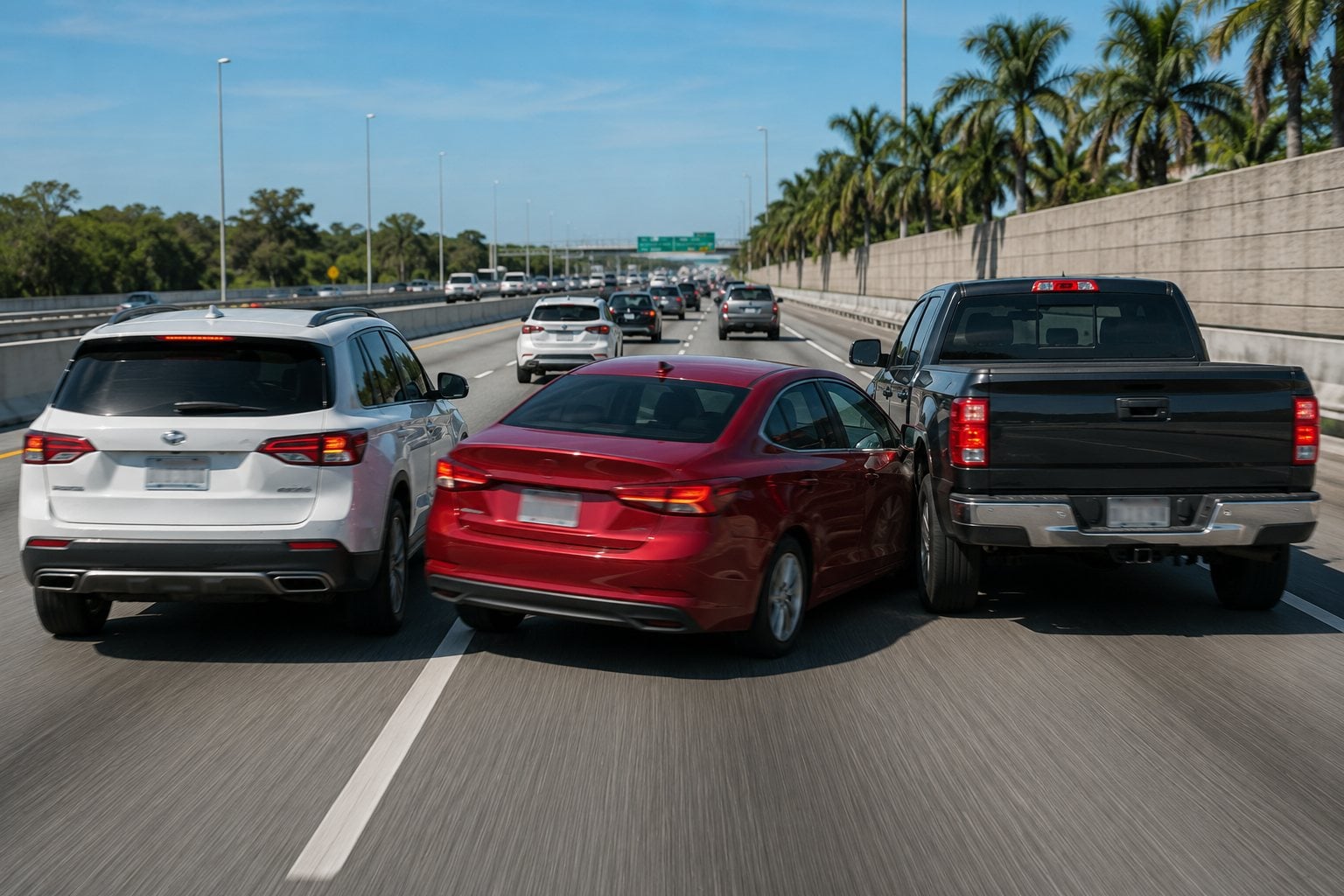
An aggressive lane switching crash is one of the most common patterns of multi vehicle wrecks on I 95, the Turnpike, I 75, I 595, and the major surface roads through Broward and Palm Beach. The combination of stop and go traffic, short merge zones, and drivers trying to gain a single car length is exactly the setup that turns a routine commute into a serious injury claim. Understanding how these crashes are reconstructed and who is held responsible is the difference between a fair recovery and a long fight with an insurance company.
What Counts as an Aggressive Lane Switching Crash
An aggressive lane switching crash is any collision caused by a driver who changes lanes in a way that is sudden, unsignaled, repeated across multiple lanes, or done with insufficient space between vehicles. It includes weaving through traffic to get ahead, cutting in front of a slower car at the last second to make an exit, swerving across a solid white line to pass on the shoulder, and crossing two or three lanes in a single move during heavy traffic. The Florida statute on changing lanes is clear, you must use a turn signal and yield to traffic already in the destination lane.
How Common Aggressive Lane Switching Has Become on Florida Roads
Florida interstates regularly post some of the highest traffic counts in the southeast, and Broward and Miami Dade carry hundreds of thousands of vehicles every weekday, and Florida Highway Safety and Motor Vehicles crash data consistently lists improper lane changes among the top contributing factors. Sideswipe, lane departure, and improper lane change collisions together make up a meaningful percentage of all reported Florida crashes. State and county data consistently show that improper lane changes are among the top contributing factors in multi vehicle injury crashes. An aggressive lane switching crash is the predictable result of routine traffic plus drivers who treat the white dashed line as a suggestion.
Why Drivers Switch Lanes Aggressively
The reasons behind an aggressive lane switching crash usually fall into three buckets. The first is time pressure, drivers running late and convinced that the next lane is moving faster. The second is distraction, drivers glancing at a phone or a GPS and reacting late when their exit appears. The third is anger or impatience, drivers passing on the right, retaliating against a perceived slight, or trying to keep a tight pack of cars from boxing them in. Florida summer heat, tourist traffic, and rush hour congestion all add to the pressure.
Common Locations for Aggressive Lane Switching Crashes
The highest concentration of aggressive lane switching crash reports comes from the approach to busy interchanges, like the I 95 and I 595 interchange in Davie, the Turnpike split in Sunrise, and the I 75 and Sawgrass Expressway interchange. Surface road danger zones include University Drive, Sample Road, Federal Highway during commuter hours, and the corridors near the Sawgrass Mills and Aventura malls on weekends. Heavy merging and lane drops create the conditions where one impatient driver triggers a chain.
What Typically Happens After an Aggressive Lane Switching Crash
The mechanics of an aggressive lane switching crash usually involve a low angle sideswipe followed by a secondary impact. The first car gets clipped at the front quarter panel, oversteers in response, and either spins into the next lane or brakes hard, which then causes a rear end collision behind it. Injuries from these crashes are often neck and back soft tissue injuries, shoulder strains from gripping the wheel, and concussion symptoms from the second impact. Property damage usually involves more than one vehicle, which complicates the insurance picture.
Summary of Aggressive Lane Switching Crash Liability
Florida operates under a no fault insurance system, so the first stop is your own PIP coverage for medical bills and a portion of lost wages. When the injury crosses the threshold for permanent or significant impairment, you can step outside of no fault and pursue a bodily injury claim against the lane changer and any other negligent driver. In an aggressive lane switching crash, fault is usually established with dashcam footage, traffic camera review, paint transfer analysis, and witness statements. The lane changer is almost always primarily at fault when they failed to yield to traffic already in the lane.
FAQs About Aggressive Lane Switching Crashes
Who is at fault in an aggressive lane switching crash?
The driver changing lanes has the duty to yield. In most cases, that driver is found primarily at fault for failing to make a safe lane change.
What if the aggressive driver left the scene?
You may have an uninsured motorist claim under your own policy if the at fault driver cannot be identified. Police, witness, and camera evidence are critical.
Is weaving in heavy traffic illegal in Florida?
Yes. Florida law requires lane changes to be signaled, safe, and yield to existing traffic. Weaving repeatedly across multiple lanes can also support a reckless driving charge.
Can I file a claim if I was hit during a sideswipe but the other driver had no insurance?
Yes. Florida drivers commonly carry uninsured and underinsured motorist coverage to cover exactly that situation. We can help you identify every applicable policy.
Contact a South Florida Aggressive Lane Switching Crash Attorney
If you were hurt in an aggressive lane switching crash anywhere in Broward or Palm Beach, the team at Lawlor, White & Murphey can help you sort out fault and pursue a motor vehicle accident claim under Florida operates under a no fault insurance system. Call our office for a free consultation.