
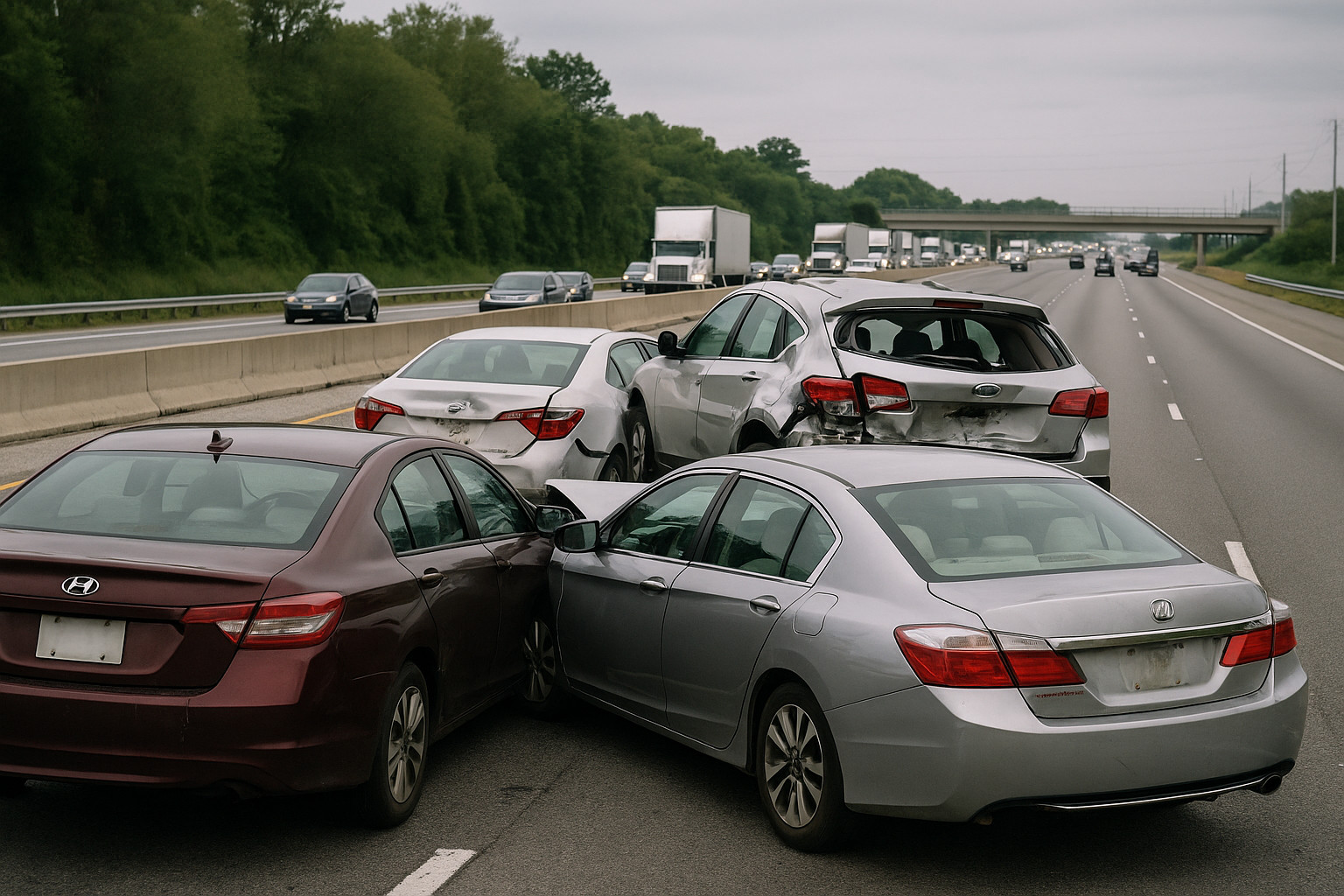
Florida’s Congested Roads and the Rise of Multi Vehicle Crashes
Florida experiences some of the most persistent traffic congestion in the country. Population growth, year round tourism, and continuous commercial development have placed enormous strain on roadway infrastructure. Major highways such as I 95, I 75, and the Florida Turnpike operate at or near capacity for much of the day. Morning and evening commutes often blend into mid day traffic, leaving few windows of consistent flow.
Unlike states with seasonal traffic fluctuations, Florida’s congestion rarely subsides. Tourists arrive throughout the year, commercial trucks move goods daily, and construction projects attempt to keep pace with growth. These overlapping demands create dense traffic conditions where vehicles travel close together, speed changes occur abruptly, and driver error becomes far more consequential.
Florida congestion does not just make driving slower. It changes the way crashes happen. Multi vehicle collisions and chain reaction crashes become more likely because traffic compresses, visibility drops, and drivers have less time to process what is happening ahead. This guide explains why congested crash risks increase on Florida roads, what types of driving patterns trigger multi car collisions, and why injuries in these crashes can be serious even when speeds are not extremely high.
Why Does Traffic Congestion Increase the Risk of Multi Vehicle Crashes?
Many drivers assume multi vehicle crashes only happen during severe weather or at high speeds. In reality, congestion creates its own crash environment. Stop and go movement, tightly packed lanes, and constant merging reduce the space and time drivers need to avoid an impact.
In heavy traffic, one sudden slowdown can trigger multiple collisions within seconds. Drivers farther back may not see brake lights until the line of traffic is already stopped. Even drivers who are paying attention may not have enough distance to stop safely. That is why congested crash risks rise sharply during peak commute hours, weekend travel surges, and tourist heavy seasons.
1. Stop and Go Speed Changes
Florida highways often shift from highway speed to near zero with little warning. Drivers may accelerate for a short stretch and then brake hard when traffic compresses again. This constant fluctuation increases the chance of late braking, especially when drivers are tired or distracted.
2. Unpredictable Lane Changes and Merging
Congestion leads to frequent lane hopping. Drivers change lanes to get ahead, reach exits, or avoid slow moving vehicles. Each lane change introduces risk, especially when spacing is tight and visibility is limited.
3. Limited Following Distance
In dense traffic, vehicles travel closer together than they should. Drivers may shorten following distance to prevent others from cutting in. When the vehicle ahead brakes suddenly, the reduced gap leaves little room to stop safely.
How Congestion Creates Chain Reaction Collisions
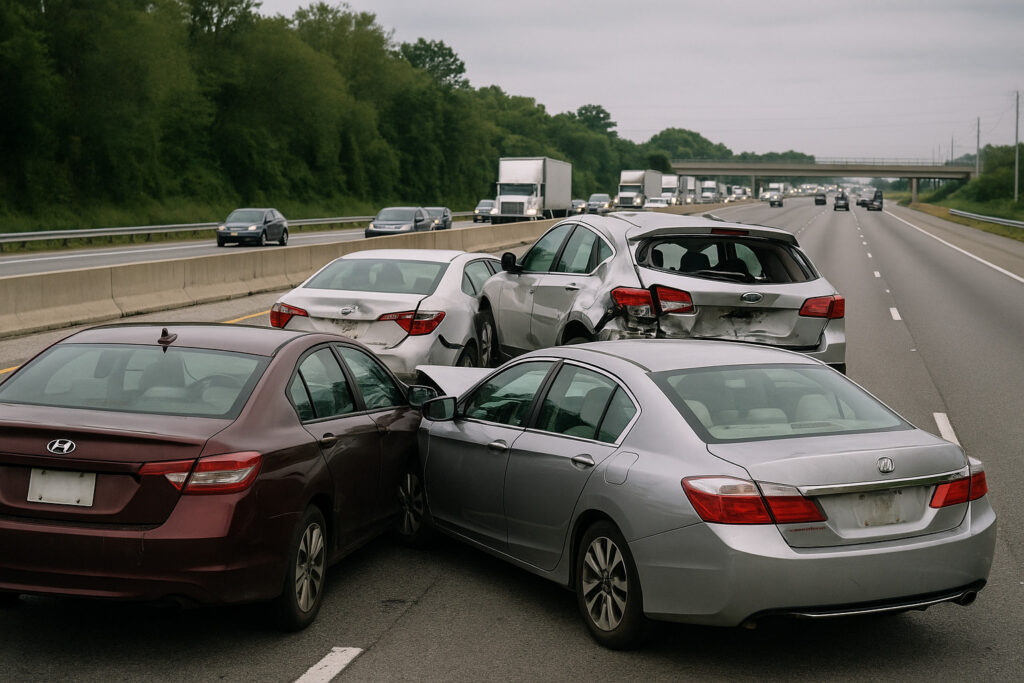
Chain reaction collisions typically start with one event, then spread. A single rear end impact can push vehicles forward while drivers behind brake hard and collide. The result is often a multi car crash involving several lanes and multiple points of impact.
A key feature of chain reaction collisions is that they happen quickly. Drivers do not have time to assess what is happening. They are reacting to brake lights, sudden lane closures, or the sound of a crash ahead. When congestion is heavy, there is no open space to steer into and no shoulder room to escape.
Common Triggers in Florida Chain Reaction Crashes
Examples include:
- A driver braking abruptly near a busy interchange because they nearly missed an exit.
- Traffic slowing at a bridge approach where lanes narrow and visibility drops.
- A minor crash ahead that causes sudden stopping behind it before drivers can react.
- A vehicle merging aggressively into a tight gap and forcing others to brake hard.
- Construction related slowdowns where barriers prevent drivers from maneuvering away.
Why Florida Highways Are Especially Vulnerable
Florida’s crash patterns are influenced by the specific way traffic flows in the state. Many highways carry a constant mix of local commuters, tourists unfamiliar with road layouts, and commercial trucks moving freight between major metros. These groups drive differently, and that mismatch increases risk during congestion.
Congested crash risks are often highest in areas where multiple traffic streams converge. Interchanges, toll plazas, airport corridors, and coastal routes feeding beaches and marinas are common examples. When traffic compresses in these locations, a small mistake can create a multi vehicle event.
High Risk Factors That Increase Congestion Crashes
Several conditions make Florida congestion more dangerous:
- High traffic volume that remains steady across most months rather than dropping seasonally.
- Multiple major highways intersecting near dense urban centers.
Frequent roadwork and lane shifts as infrastructure expands. - A high number of visitors relying on navigation apps and making last second lane changes.
- Commercial vehicle traffic that increases stopping distance and blocks visibility.
Injury Risks in Multi Vehicle Crashes
Multi vehicle crashes often cause injuries that are more complex than a typical two car collision. One reason is the number of impacts. A person may be hit from behind, pushed forward, then struck again. That repeated force can strain the body in ways that create both immediate and delayed symptoms.
Even when speeds are lower, the body can still experience significant acceleration and deceleration forces. The head and neck are particularly vulnerable. Back injuries are also common, especially when the spine is compressed or twisted during multiple impacts.
Injuries Frequently Seen After Chain Reaction Collisions
These crashes often involve:
- Whiplash and soft tissue injuries in the neck and upper back.
- Herniated discs or aggravated spinal conditions from repeated jolting.
- Concussions and traumatic brain injuries from rapid head movement.
- Fractures in the wrist, arm, or ribs from bracing or seat belt force.
- Knee and lower leg injuries from contact with the dashboard area.
- Anxiety, driving related fear, and sleep disruption following a traumatic crash.
Some people feel shaken but assume they are fine because there is no visible injury. In reality, symptoms can emerge later, especially after inflammation sets in or the nervous system begins reacting to trauma.
Insurance and Claim Complications in Multi Vehicle Crashes
Multi vehicle crashes often lead to complex insurance disputes. Unlike a simple rear end collision, there may be multiple contributing factors and multiple drivers involved. Insurance adjusters may disagree on who triggered the chain reaction and how much responsibility each driver carries.
This complexity can delay the claim process. It can also increase the need for detailed documentation. When multiple vehicles are involved, evidence such as crash reports, witness statements, and medical records becomes even more important because insurers may attempt to shift blame.
Why These Claims Are Often Disputed
Common issues include:
- Conflicting statements from drivers about who braked first or who changed lanes.
- Multiple insurance policies with different limits and coverage types.
- Arguments about whether a later impact caused a particular injury.
- Delays in obtaining full police reports due to the size of the crash scene.
- Difficulty identifying the order of impacts, especially when vehicles are moved.
What To Do After a Congestion Related Multi Vehicle Crash
The steps taken after a crash can matter for both health and documentation. Multi vehicle collisions often involve adrenaline, confusion, and rapidly changing conditions at the scene. That can lead people to overlook symptoms or fail to record key details.
Step by step actions that are commonly recommended include:
Step 1: Get medical evaluation even if symptoms seem minor.
Step 2: Request the crash report number and note the responding agency.
Step 3: Photograph vehicle positions, damage, road conditions, and any debris if it is safe.
Step 4: Collect contact information from witnesses when possible.
Step 5: Keep records of symptoms, appointments, and work limitations as they develop.
This is especially important in chain reaction crashes because symptoms can appear later and injuries may be blamed on another impact in the sequence.
Frequently Asked Questions
Why are multi vehicle crashes so common in Florida traffic?
Florida has heavy year round congestion driven by population growth, tourism, and commercial transport. When highways operate near capacity, traffic compresses and speed changes become sudden. That environment increases the likelihood that one delayed braking event will trigger a chain reaction crash involving multiple vehicles.
Can injuries be serious even if traffic was moving slowly?
Yes. Stop and go collisions can still create significant force, especially when impacts happen more than once. Repeated jolting increases the risk of neck and back injuries, concussions, and aggravated spine conditions. Some symptoms may appear hours or days later, particularly headaches, dizziness, and stiffness.
Why do insurance claims take longer after multi vehicle crashes?
These collisions often involve multiple drivers and conflicting accounts. Insurers may dispute who triggered the crash and how responsibility should be divided. Medical documentation and clear evidence are often critical because insurers may argue about which impact caused the injury.
What if a truck was involved in the chain reaction?
Commercial vehicles require longer stopping distances and can block visibility for drivers behind them. When a truck is involved, injuries are often more severe due to the size and weight difference. The investigation may also involve additional documentation such as driver logs, company records, and policy limits.
Do symptoms sometimes show up days after a chain reaction crash?
Yes. Delayed symptoms are common, especially with concussions, soft tissue injuries, and back injuries. Adrenaline may mask pain at the scene. Inflammation and muscle tightness may increase in the days that follow, making symptoms more noticeable later.
Summary: Why Congestion Makes These Crashes Predictable
Florida’s traffic congestion creates conditions where multi vehicle crashes become more likely. Tight spacing, sudden braking, lane changes, tourist driving behavior, distracted motorists, commercial trucks, and construction zones all contribute to congested crash risks. When traffic is dense, drivers have fewer escape routes and less time to react, which is why one small event can quickly become a chain reaction collision.
Because injuries and liability can be more complicated in these crashes, documentation and medical evaluation are often central issues. Understanding how congestion changes crash dynamics helps explain why multi car collisions happen so frequently across Florida highways and why the aftermath can be physically, emotionally, and financially disruptive.
Contact Lawlor, White & Murphey Today
If you or someone you know has experienced delayed medical care after a car accident, don’t wait any longer. Your health and your legal rights depend on timely action. Speak with a qualified personal injury attorney who can guide you through the process, help you gather evidence, and fight for the compensation you deserve.
Take the next step—schedule a free consultation with Lawlor, White & Murphey today.