Can I Sue a Mechanic If a Bad Repair Caused My Car Accident in Florida?
Yes, in many cases you can sue a mechanic in Florida if careless/negligent repair work caused your crash. Repair shops generally owe their customers reasonable care, and a faulty brake job, loose lug nuts or bad steering work may support a negligence claim against the shop, alongside any claim against an at-fault driver or a parts maker.
These claims turn on proof. The shop and its insurer will often argue that the repair was done correctly and that something else caused the failure, such as a defective part, a later problem or the way the car was driven. Knowing what evidence connects the repair to the crash, and how quickly it can disappear, helps protect a claim before it starts.
What Counts as a Bad Repair When You Sue a Mechanic in Florida
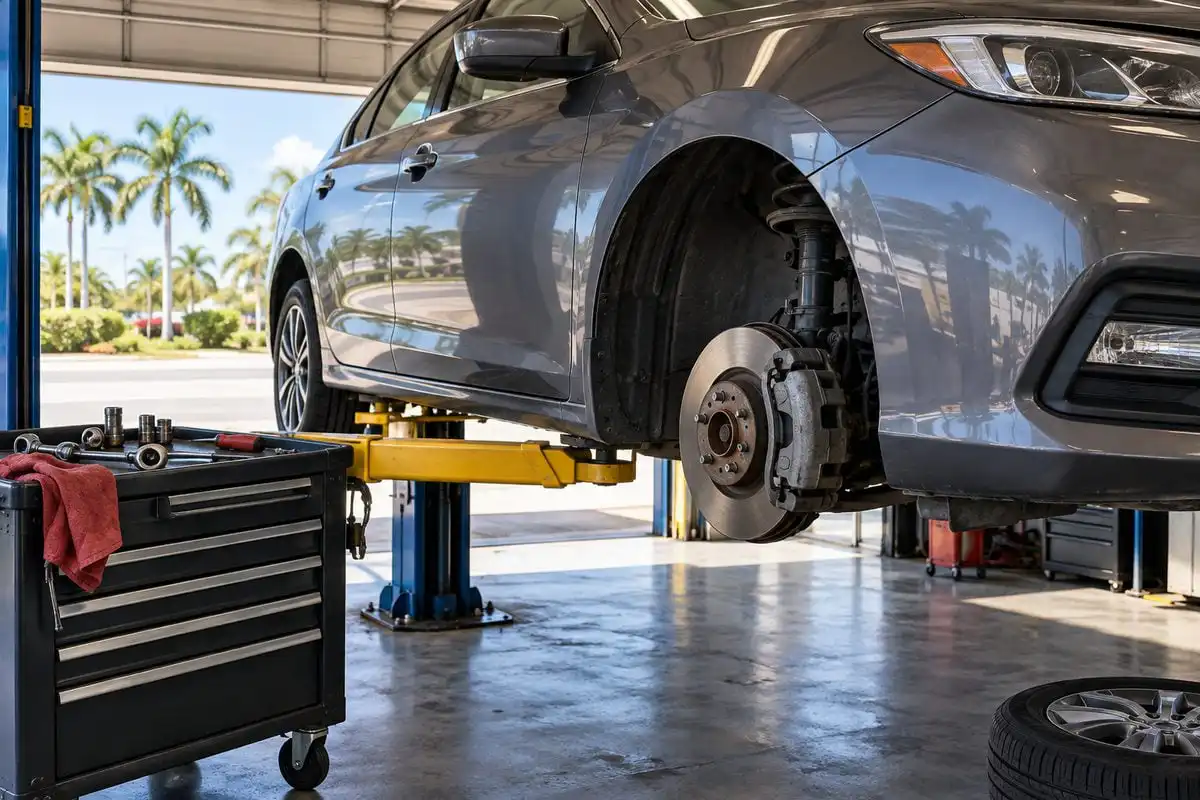
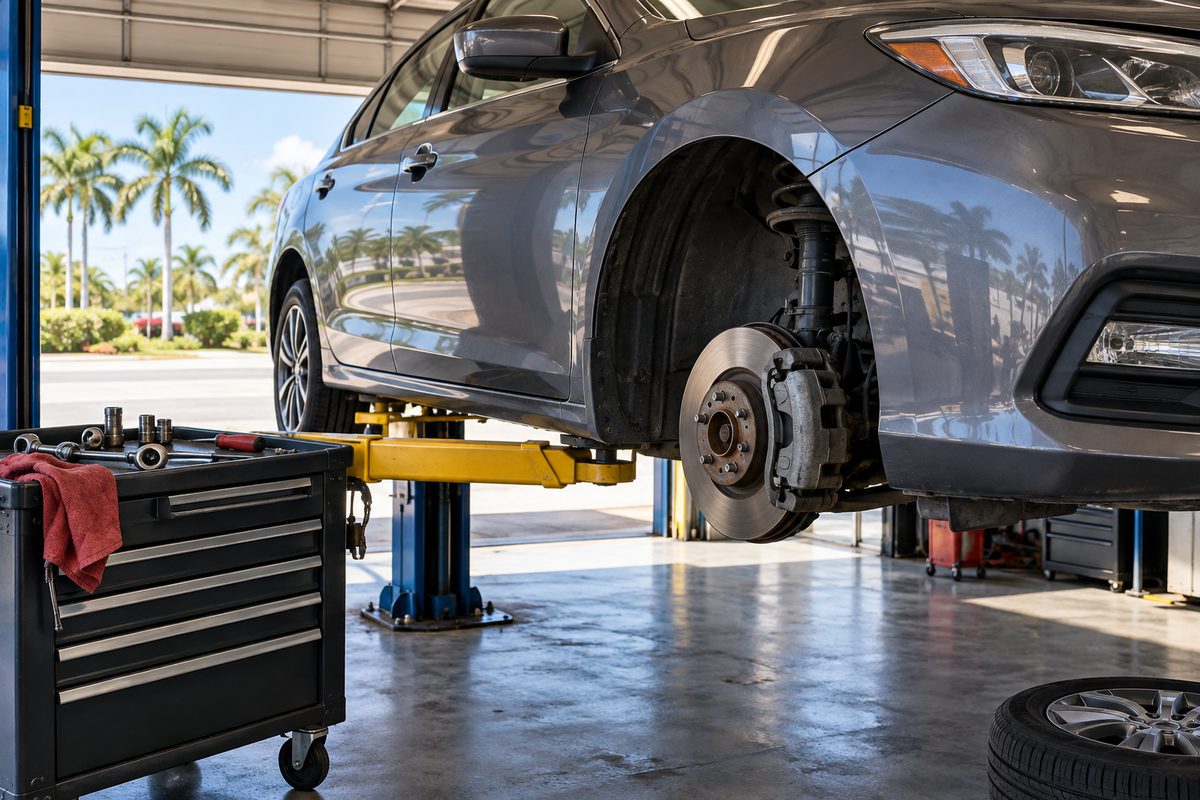
A repair shop that works on your vehicle generally owes you reasonable care, meaning the skill and attention a careful and reasonable shop would bring to the same job. A bad repair is work that falls below that standard. Examples include a brake job with the wrong pads or a component left loose, tires mounted improperly, lug nuts that were never tightened, and steering or suspension parts that were reassembled incorrectly.
A crash alone does not prove the repair was bad. A claim generally has to show that the shop’s work fell below the standard of reasonable care and that this failure caused the crash and your injuries. Timing often matters: a wheel that comes off days after new tires were mounted points in a different direction than a brake problem that appears long after the last brake service.
When a Florida Crash Leads Drivers to Sue a Mechanic
The question usually comes up after a crash that followed recent work on the car. A driver picks up a car after a brake job and the pedal goes soft on the drive home, or a wheel separates on the highway a few days after new tires were installed. Steering that suddenly binds after front-end work, or a suspension part that breaks soon after it was replaced, can raise the same question.
The Florida Department of Highway Safety and Motor Vehicles publishes statewide crash and citation reports each year. On crowded roads across Broward County and Palm Beach County, a car that cannot stop or steer can quickly involve other vehicles, so a bad repair may hurt the driver, passengers and people in other cars, and those people may have claims of their own.
Why It Matters Whether You Can Sue a Mechanic
It matters because the mechanic may be the party whose mistake actually caused the crash. If only your vehicle was involved, or the other driver did nothing wrong, a claim against the shop may be the main path to compensation beyond your own insurance. Florida operates under a no-fault insurance system, so your Personal Injury Protection coverage pays first regardless of fault, and initial treatment within 14 days is generally required to use it.
PIP generally pays 80 percent of reasonable medical expenses, and the $10,000 is one combined limit that also covers lost wages if your policy includes wage loss coverage. That amount often falls short after a significant injury. To recover pain and suffering from the owner or driver of an insured vehicle, an injury generally must meet Florida’s injury threshold: a significant and permanent loss of an important bodily function, a permanent injury within a reasonable degree of medical probability, or significant and permanent scarring or disfigurement. A claim against a repair shop can work differently, which is one more reason to have the facts reviewed early.
Evidence You Need to Sue a Mechanic for a Bad Repair
The paperwork from the repair is often the starting point. Florida’s Motor Vehicle Repair Act generally requires a shop to prepare a written estimate before work that will cost more than $150, including a description of the problem you reported, and to give you an invoice when the work is finished. The invoice must describe what was done, itemize the labor and parts, and identify any replacement part that was used, rebuilt or reconditioned.
If you asked when you authorized the work, the Act also generally lets you inspect the parts removed from your vehicle, and in some cases have them returned. After a crash, the vehicle and the parts involved in the repair should be preserved for an independent inspection by qualified professionals, such as engineers, accident reconstructionists or mechanics, before anything else is fixed. Work orders, messages with the shop and records of any complaints you raised after the repair can show what the shop knew and when.
Sometimes the inspection points away from the shop. If the part itself was defective, the manufacturer or parts maker may be responsible instead, through defective product claims based on a design defect, a manufacturing defect, a failure to warn, negligence or breach of warranty. A worn part, a defective part and a careless installation can look alike after a crash, which is part of why brake failure collisions often involve several possible defendants.
How the 51% Bar Applies When You Sue a Mechanic
Florida follows a modified comparative negligence rule under section 768.81 of the Florida Statutes. If you are found more than 50% at fault for your own harm, you cannot recover any damages, and otherwise your award is reduced by your percentage of fault. The statute’s definition of a negligence action includes strict liability and products liability, so the same rule applies when a parts maker is part of the case.
The statute also generally divides responsibility among the parties who contributed, with each one typically responsible for its own share rather than the whole award. In a repair case, the shop may argue that you ignored a warning light, declined a recommended repair or kept driving after a problem appeared. It may also point to the parts maker or another driver. Records of what the shop told you, and when, often answer those arguments.
What Typically Happens After You Sue a Mechanic in Florida
Like other motor vehicle accident claims, most repair claims begin long before a lawsuit. Once treatment is underway, the evidence is gathered and the vehicle is inspected, the claim is usually presented to the shop’s insurer through a settlement package that documents the injuries, the losses and the proof of what went wrong. Many claims resolve through negotiation, and some move into litigation when the parties cannot agree.
Timing is important. Florida generally gives you two years from the date of the crash to file a negligence lawsuit against the at-fault party. Claims against a manufacturer, parts maker or seller can follow different deadlines, and Florida also has a statute of repose for product claims, so the timing can be complicated and is worth reviewing early. The vehicle and the removed parts should be preserved well before any deadline approaches.
Summary of When You Can Sue a Mechanic in Florida
You may be able to sue a mechanic in Florida when careless repair work caused your crash, but the claim depends on evidence that connects the repair to the failure. The essential points to remember are:
- Repair shops generally owe customers a duty of reasonable care in the work they perform.
- Brake jobs, tire mounting, lug nuts and steering or suspension work are frequent sources of repair claims.
- Estimates, invoices, work orders and the removed parts can be key evidence.
- A defective part may point responsibility toward the parts maker instead of the shop.
- Your own PIP coverage pays first, and treatment within 14 days is generally required.
- Florida generally gives you two years from the date of the crash to file a negligence lawsuit against the at-fault party.
FAQs About When You Can Sue a Mechanic in Florida
Can I sue a mechanic if the shop says the part was defective?
Possibly. The shop may argue that the part, not its work, caused the failure. An independent inspection can help show whether the part was defective, whether it was installed correctly or both, and a parts maker may share responsibility with the shop.
Do I need to keep the old parts from a repair?
It often helps. If you ask when you authorize the work, Florida’s Motor Vehicle Repair Act generally lets you inspect the parts removed from your vehicle, and in some cases have them returned. After a crash, keep the vehicle and any parts you have until they can be inspected.
What if I ignored a warning light after the repair?
It may reduce your recovery. Under Florida’s modified comparative negligence rule, your award is reduced by your share of fault, and you cannot recover if you are found more than 50 percent at fault, so the full facts of what the shop told you matter.
Does my PIP coverage apply if a mechanic caused the crash?
Generally, yes. Your own Personal Injury Protection coverage pays first regardless of fault, generally 80% of reasonable medical expenses within the $10,000 limit, which covers lost wages if your policy includes wage loss coverage. Initial treatment within 14 days is generally required, along with emergency medical care to receive the full extent of your benefits.
How long do I have to sue a mechanic after a Florida car accident?
Florida generally gives you two years from the date of the crash to file a negligence lawsuit against the at-fault party. Claims involving a defective part can follow different deadlines, and Florida also has a statute of repose for product claims, so the timing is worth reviewing early.
Contact a South Florida Car Accident Lawyer
If a bad repair played a role in your crash, the team at Lawlor, White & Murphey can review the repair records and explain your options. We represent injured people throughout Florida, including Broward and Palm Beach County, and we can help preserve the vehicle and the parts before key evidence is lost. You can call our office at 954-525-2345 to talk through what happened. Our Fort Lauderdale office is located at 2211 Davie Boulevard, Fort Lauderdale, FL 33312.
This article is for general information only and is not legal advice. Every case is different, and past results do not guarantee a similar outcome.