
Roundabout Collisions: Why Yield and Lane Confusion Cause Serious Crashes
Roundabouts are supposed to make intersections safer, and in many ways they do. By keeping traffic moving in one direction at lower speeds, they remove the high-speed, right-angle crashes that make traditional intersections so dangerous. But roundabouts only work when everyone understands how to use them, and on Florida roads that is far from guaranteed.
As more roundabouts appear across the state, so do the crashes that come from drivers who are unsure when to yield, which lane to choose, or when it is their turn to enter. A moment of hesitation or a wrong-lane exit is often all it takes. If you were hurt in a roundabout collision, you may be surprised how much confusion there is about who had the right of way. This guide walks through how Florida sorts out fault after a roundabout collision.
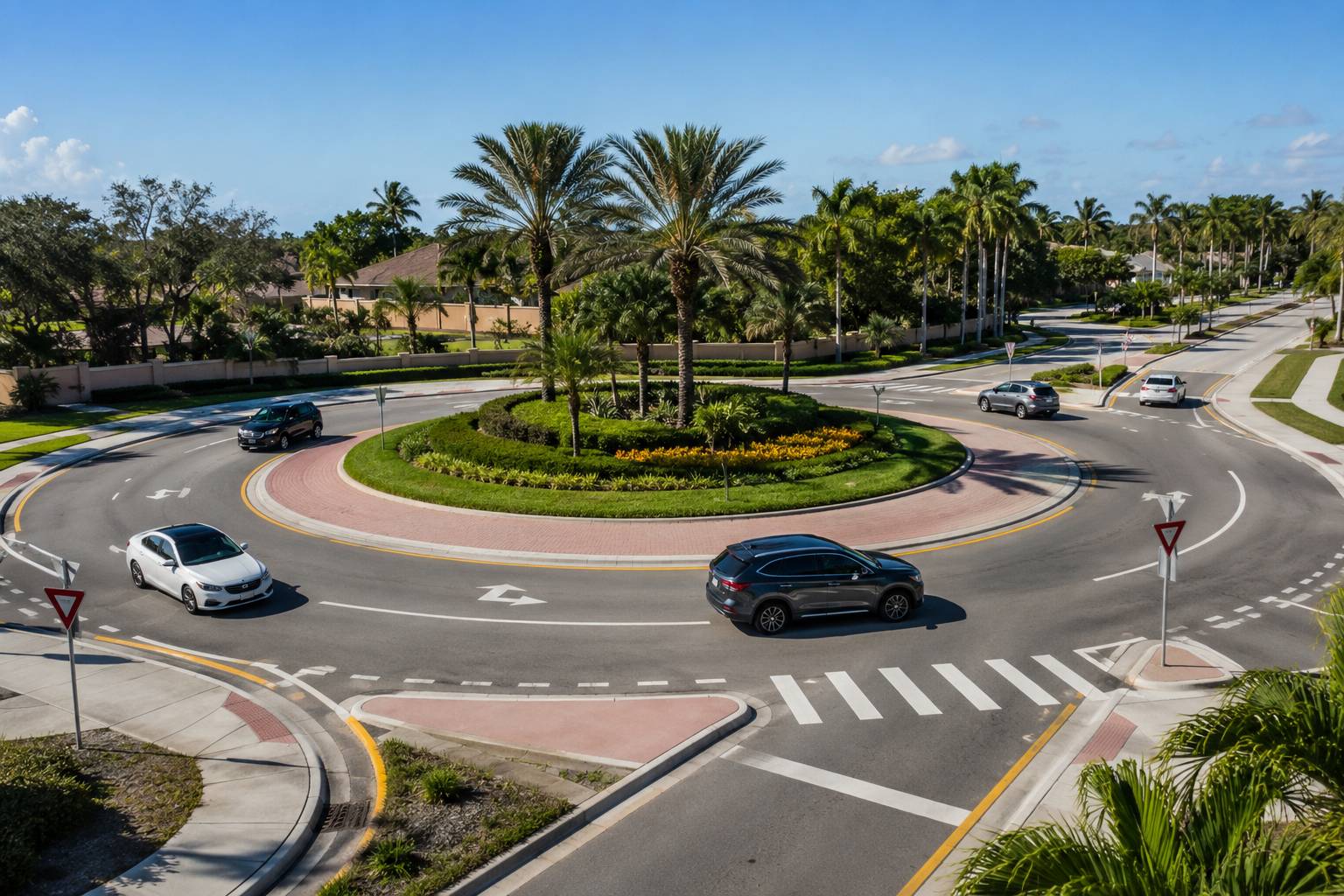
What Counts as a Roundabout Collision
A roundabout collision is a crash that happens as vehicles enter, travel through, or exit a circular intersection. It belongs to the wider family of motor vehicle collisions, but the fault analysis is shaped by the specific rules that govern roundabouts. Because traffic flows one way around a central island, the classic head-on and high-speed T-bone crashes are rare, and the typical roundabout collision is a sideswipe, an angle impact at an entry point, or a rear-end as traffic slows to yield.
These crashes fall into a few recognizable patterns. A driver enters without yielding and strikes a vehicle already circulating, two drivers in a multi-lane roundabout sideswipe each other while changing lanes or exiting, or a driver stops unexpectedly and is struck from behind. Each pattern points back to a different failure, which is why identifying exactly what happened is the first step in a roundabout collision claim.
Why Roundabout Collisions Happen in Florida
Roundabouts are still relatively new to many Florida drivers, and unfamiliarity is the root of most of these crashes. You can review the state’s broader crash trends through the Florida crash and citation data published by the FLHSMV, which tracks reported crashes and their locations each year as roundabouts continue to be added to Florida roads. The core problem is simple: a design that works smoothly when drivers know the rules breaks down when they do not.
The confusion takes a few forms. Some drivers do not realize that traffic entering the roundabout must yield to traffic already circulating, so they pull out into a gap that is not there. In multi-lane roundabouts, drivers pick the wrong lane for the exit they want and cut across at the last second. Across Broward and Palm Beach County, newer roundabouts draw a steady mix of local commuters and visitors unfamiliar with the specific layout, which multiplies the chances for a misjudged entry or a wrong-lane exit.
Why Roundabout Collisions Cause Serious Injuries
Roundabouts lower speeds, so they tend to produce fewer fatal crashes than traditional intersections. That does not mean the injuries are minor. An angle impact at an entry point or a sideswipe in a multi-lane roundabout can still jolt the body hard enough to cause whiplash, herniated discs, shoulder injuries, and lasting neck and back pain, particularly when the struck driver never saw it coming.
The more serious risk in a roundabout is to people outside a vehicle. Roundabouts have crosswalks at each entry and exit, and a driver focused on merging into the circle may fail to notice a pedestrian or cyclist stepping off the curb. A strike in that setting, even at a modest speed, can cause severe injuries. As with any crash, symptoms such as concussion or soft-tissue damage can take a day or two to appear, so a prompt medical check is wise.
Proving Fault in a Roundabout Collision
Fault in a roundabout collision usually comes down to one question: who had the right of way? Florida law requires drivers entering a roundabout to yield to traffic already circulating within it. A driver who enters into oncoming circulating traffic and causes a collision is typically at fault, much as a driver who fails to yield at any other intersection would be.
Proving it means reconstructing the movement of each vehicle. The crash report, the position of the vehicles, the lane markings and yield signs, and any traffic camera or dashcam footage help show who entered when and whether a driver was in the correct lane. Witness accounts are especially valuable in multi-lane roundabouts, where a wrong-lane exit or an improper lane change can be hard to see from the physical evidence alone.
How Florida’s No-Fault Rules Apply After a Roundabout Collision
Florida operates under a no-fault insurance system, which governs the first steps after a roundabout collision. You file first with your own personal injury protection, or PIP, coverage, which pays up to 10,000 dollars toward medical care regardless of who failed to yield. The full 10,000 dollars is available only if a medical provider determines you had an emergency medical condition. Without that determination, PIP medical benefits are generally capped at 2,500 dollars. As always, treatment must begin within 14 days of the crash, or those PIP benefits can be denied.
If your injuries are serious enough to meet the Florida serious injury threshold, you can step outside the no-fault system and pursue the at-fault driver for the full range of your losses, which matters most for pedestrians and cyclists struck at a roundabout crosswalk. If the at-fault driver is uninsured or underinsured, your own uninsured and underinsured motorist coverage may help. For most crashes on or after March 24, 2023, you have two years from the date of the collision to file a lawsuit.
What to Do After a Roundabout Collision
After a roundabout collision, move to a safe spot if the vehicles are drivable and call 911 so the crash is on record. Because fault so often depends on lane position and yielding, try to photograph the roundabout itself, including the lane markings, yield signs, and where each vehicle came to rest. These details fade from memory quickly and are hard to reconstruct later.
Get the contact information of any witnesses, since their view of who entered first can settle a disputed claim. Seek medical care promptly even for what feels like a minor jolt, both because injuries can be delayed and because the 14-day PIP deadline is strict. Avoid debating fault at the scene, and keep records of your treatment, expenses, and any time missed from work.
What Compensation a Roundabout Collision Victim Can Recover
When another driver’s failure to yield or improper lane change causes a roundabout collision, you can seek compensation for the losses that follow. Recoverable damages can include past and future medical bills, rehabilitation, lost income, reduced earning capacity, and pain and suffering. For a pedestrian or cyclist struck at a roundabout, those medical needs can be extensive.
What you recover depends on the evidence and the severity of your injuries, reduced by any share of fault assigned to you. Our firm handles these cases on a contingency fee of 33 1/3 percent before a lawsuit is filed and 40 percent afterward, and you pay no attorney fee unless we recover money for you. Every case is evaluated on its own facts.
How Comparative Negligence Can Reduce a Roundabout Collision Claim
Because roundabout collisions often involve two drivers who each made a questionable move, comparative negligence comes up frequently. Florida’s modified comparative negligence rule reduces your compensation by your percentage of fault, and a person found more than 50 percent at fault recovers nothing under the state’s 51 percent bar.
In a roundabout, an insurer might argue that you were in the wrong lane, entered too aggressively, or failed to signal your exit, even when the other driver failed to yield. These are exactly the arguments that shift a few percentage points of blame and lower a recovery. Clear evidence of the lane markings, the yield rule, and each driver’s path is what keeps the fault assigned accurately.
Summary of Roundabout Collision Claims
A roundabout collision usually traces back to a missed yield or a wrong-lane move, and Florida law provides a path to recovery for the people who are hurt. Keep these points in mind.
- Most roundabout collisions come from a driver failing to yield or choosing the wrong lane.
- Traffic entering must yield to vehicles already circulating in the roundabout.
- Speeds are lower, but sideswipes, angle impacts, and pedestrian strikes still cause real injuries.
- PIP pays up to 10,000 dollars first, and treatment must begin within 14 days.
- Florida uses modified comparative negligence with a 51 percent bar to recovery.
- Most claims must be filed within two years, and attorney fees are contingency based.
Frequently Asked Questions About Roundabout Collisions
Who has the right of way in a Florida roundabout?
Drivers already circulating in the roundabout have the right of way, and vehicles entering must yield to them. A driver who enters into circulating traffic and causes a crash is usually at fault, though the full picture still has to be proven with evidence.
What if I was partly at fault for the roundabout collision?
Florida uses modified comparative negligence with a 51 percent bar. If you are more than half at fault you recover nothing, and if you are 50 percent or less at fault your compensation is reduced by your share, so a partial fault defense is worth challenging with evidence.
Does PIP cover my injuries after a roundabout collision?
Yes. Florida’s no-fault system requires you to file first with your own personal injury protection coverage, which pays up to 10,000 dollars for medical care regardless of fault. You must begin treatment within 14 days of the crash for those benefits to apply.
How long do I have to file a claim after a roundabout collision?
For most negligence claims arising after March 24, 2023, Florida gives you two years from the date of the crash to file a lawsuit. Because roundabout fault often depends on witness accounts, acting early helps preserve that testimony before memories fade.
What does it cost to hire a lawyer for a roundabout collision?
Our firm handles these cases on a contingency fee, which is 33 1/3 percent before a lawsuit is filed and 40 percent afterward. You pay no attorney fee unless we recover money for you, so there is no upfront cost to discuss your case.
Contact a South Florida Roundabout Collision Lawyer
If another driver’s confusion at a roundabout left you injured, you should not have to sort out PIP, fault, and deadlines on your own. Our attorneys help people throughout Florida, including Broward and Palm Beach County, understand their options and pursue full recovery after a roundabout collision. You can read about our attorneys and how we handle these cases as you weigh your next step. Past results do not guarantee a similar outcome, and every case is evaluated on its own facts.
To speak with someone about your case, call our office at 954-525-2345 for a free consultation. Our Fort Lauderdale office is located at 2211 Davie Boulevard, Fort Lauderdale, FL 33312, and we serve injured clients across the state.
This article is for general information only and is not legal advice. Every case is different, and past results do not guarantee a similar outcome.